

Not everyone heads outdoors thinking about birds, but in Yellowstone country, birds are part of almost every day outside. In Yellowstone National Park and the surrounding area, birds can add value to your total experience. Whether you are hiking, biking, fishing, or sitting around camp, learning a few birding basics can help you notice more of the country around you.
Start with observation, not identification
The first step is simple: constantly observe. Develop a natural awareness of all that is around you.
Movement, sight, and sound often clue us in to the presence of birds. When you notice a bird, pay attention to the basics before you worry about the name. Look at the shape. Notice the size. Catch the color pattern. Watch the behavior. Is it on the ground, on a branch, over water, or climbing through brush? Does it glide, flap, bob, hop, soar, or dart? How is that bird interacting with its own world?
And listen.
A call may give away a bird long before you see it. Sometimes the voice is the best clue you get, especially in timber, streamside brush, or evening light. The more you practice this listening, the more you begin to pick up the details that matter. At first, it feels like there are too many birds and not enough answers. Then, over time, certain shapes, sounds, and habits begin to repeat themselves. That is when birding gets fun. You may be on a hike and consistently hear the same bird song. That may be your initial clue. Now start watching for movement and try to orient to the sound. This is when birding becomes a fun challenge. You are solving a naturalist’s puzzle.
Carry simple gear and keep it accessible
You do not need to haul around a bunch of equipment to get started. In fact, compact and practical is often better.
A smartphone can do a lot. It can take photos, record sound, save notes, and hold a field guide app with images and bird calls. That is a pretty solid birding kit for most people.
Compact binoculars are also worth carrying in your hand or in an easy-to-reach pocket, especially when they are not buried in a pack. Keep magnification at eight-power or below. That makes it easier to quickly find the bird in your field of view instead of waving your binoculars around while the bird disappears.
But the most basic gear is still the same: your own eyes and ears, plus a small pad and pen. A few quick notes about size, coloration, sound, habitat, and behavior can solve a mystery later and help build your memory in the field. Simply record what is most obvious to you. You are building familiarity.
Think habitat first
One of the easiest ways to improve your birding is to think about where you are.
Birds are not randomly scattered across the landscape. Certain species tend to show up in certain habitats, and that narrows the possibilities fast. A river corridor gives you a different set of birds than an alpine meadow. A Douglas-fir savannah offers different clues than thick willow brush or an open sage flat.
Clean rivers and streams, for example, can produce one of the signature birds of our region: the American dipper. Everybody around here should know this bird. It is one of the great little characters of western waterways, built for life around moving water and always worth watching.
When you begin matching bird to habitat, identification gets easier and your outdoor experience gets richer. You are no longer just looking at a bird. You are reading the country and relating to an individual animal.
Birding while hiking, biking, fishing, and camping
This is where it gets practical. Birding does not need to be its own separate activity. You can fold it into just about anything else you are already doing outside.
On the trail: the grouse surprise
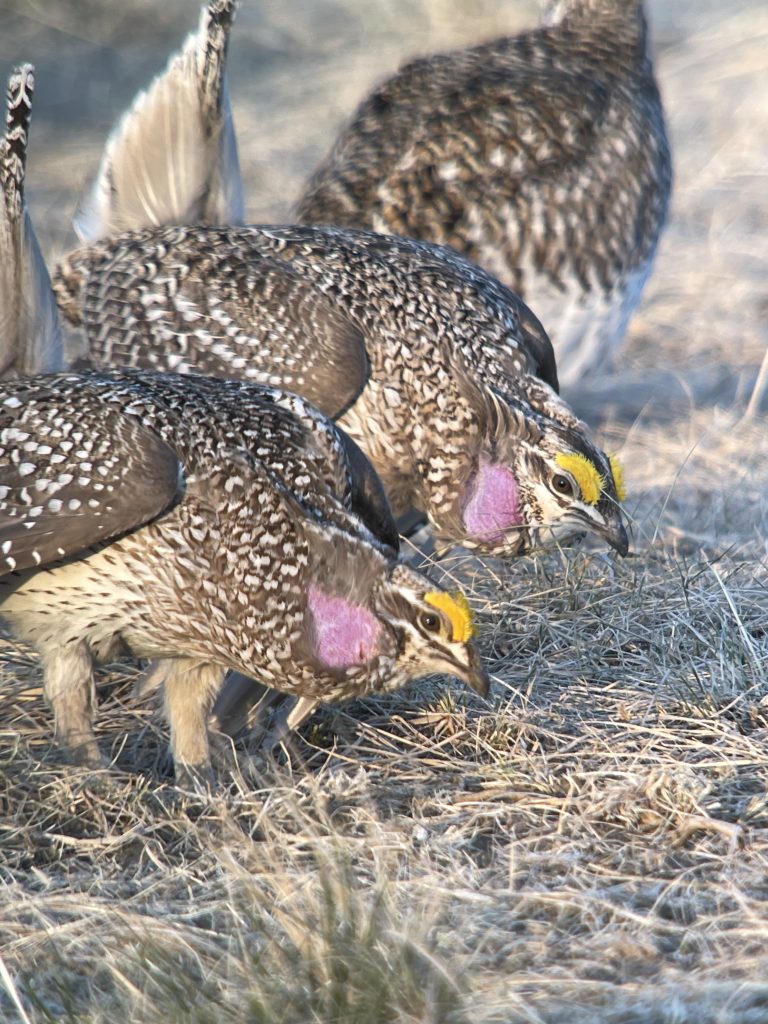
You are biking a forest trail, come around a turn, and there is a chicken-sized bird standing on the ground. Okay, it is a grouse. But what kind of grouse?
Mountain grouse can look similar at first glance, so this is where details matter. Pay close attention to the head, the neck, and the eyebrows. Those features can help separate one from another. In our mountain country, that little pause on the trail can turn into a better look at one of the classic birds of the northern Rockies. Grouse are often seen close, so use that phone and take a mini video. You may be able to use it later for a full identification.
And once you have a field guide with you, that mystery bird becomes part of the day’s story instead of just a blur that ran into the brush.
In the Douglas-fir savannah: the bird that keeps moving ahead of you
You are hiking through open timber and scattered Douglas-fir, and little sparrow-sized birds keep flying ahead from the ground to low branches. They seem to stay just in front of you, never quite still for long. Often there is an almost constant tick sound.
That is a good setup for the dark-eyed junco.
This is one of those birds that becomes obvious once you really notice it. It feeds on the ground, has a pale bill, a dark eye, and a head that usually looks darker than the rest of the body. It is common, but common should never mean uninteresting. Learning the everyday birds is one of the best ways to get better at birding because they teach your eyes what to look for.
Up high: alpine birds deserve attention too
Mid-summer finally opens the alpine ridges and meadows. Most folks look skyward for the larger birds of prey, and fair enough, but do not forget the little guys lower down.
American pipits are ground-nesting alpine birds and fit these high, open places beautifully. Mountain bluebirds may also be hunting insects in the same country, adding a flash of color to a landscape that can otherwise feel all wind, rock, and distance.
These are the kinds of moments that make birding so satisfying. The land seems big and spare, and yet it is full of life once you start slowing down enough to see it.
Along the stream: follow the sound into the brush
You are fly-casting a stream and hear a cat-like meew, sometimes mixed with a chuk. The bird you finally glimpse is about the size of a slim robin, dark gray, and moving in the brush.
That points nicely toward the gray catbird.
This is a common streamside and thicket bird, gently vocal and often overlooked because it stays partly hidden. It may also sing in a more melodic way than the name suggests. A bird like this is a good reminder that not every worthwhile wildlife encounter is large, dramatic, or easy to photograph. Some are quiet and close to the edge of your attention until you learn how to listen.
At camp near dusk: one of the strangest flyers over the river
You are camped on one of our big rivers. The sun is low. Over the water, a bird appears that flaps and glides with long, slim wings, almost bat-like in its motion. The downbeats are quick and the flight is erratic, with sudden zooming passes. Maybe you hear a sharp peent.
That bird may well be a common nighthawk.
This is one of the more unusual birds people commonly see without knowing what they saw. In flight, it has a style all its own. Perched, it nearly vanishes against bark or ground because of its cryptic coloring. To stumble onto one sitting still is an accidental sighting of the best kind.
Among the Yellowstone hot springs
You may find yourself walking the busy boardwalks among the hot springs and geysers of Yellowstone National Park. Literally millions of people walk among the iconic thermals of Yellowstone every year. Yet few notice that there is a small brown, black, and white bird walking among the colorful algae and bacteria mats that grow within the warm water runoff channels. It bobs and wanders, often pecking along the edge of the stream and among the strands of growth. If it flies, it emits a plaintive, high-pitched cry. The killdeer is a fairly common bird across North America, but in Yellowstone it is living in a unique habitat type similar to where it occurs elsewhere. A common bird in an uncommon landscape.
Why this matters
Birding is not just about checking off names. It is about natural awareness.
When you begin noticing birds, you notice more of everything else too. You pay more attention to habitat, season, weather, water, elevation, and time of day. You become a little more observant, a little more patient, and usually a little more curious. Those are all good things in the outdoors.
And in a place like the Greater Yellowstone Ecosystem, curiosity pays off. This is one of the richest landscapes in North America for wildlife and natural history. Birds belong in that bigger story. They connect river to forest, meadow to mountain, and sound to place in a way that is immediate and alive. And, ultimately, it all connects to us, and us to it. Embrace it all.
Add birds to the itinerary
So this summer, while you are out hiking, biking, fishing, floating, or just sitting in camp, add birding to the itinerary.
You do not need to become a birder overnight. Just keep your eyes open. Listen. Carry simple gear. Watch for movement and think habitat. Start with what the bird is doing before you worry about what it is called.
That small shift can change the whole day.
And around here, that means one more way to experience Yellowstone country more deeply.
For visitors who want to sharpen those skills in the field, Yellowstone Now is built around exactly this kind of experience: seeing more, understanding more, and enjoying the wildlife, birds, rivers, and landscapes of the Greater Yellowstone Ecosystem with a practiced eye and a naturalist’s perspective.
Important note
There is no doubt that if you want to learn a skill quickly, or if you want to simply experience wildlife in an unfamiliar landscape, the most efficient, and often safest, way is with a mentor. A mentor can be a friend, a tour leader, or a hired guide. But it must be someone skilled, knowledgeable, and trustworthy. YouTube, podcasts, and books can help, but nothing compares to a live person on a living landscape. It is important to keep in mind that you can have incredible experiences on your own, and it is equally important to seek these out on your own, but if you can connect with a local guide, it can magnify your experience phenomenally.